Artificial intelligence is changing the way people search for information, learn new things, and complete everyday tasks. Tools such as ChatGPT can answer questions, explain difficult topics, write content, and help businesses save time. However, even advanced AI tools have limitations. They may sometimes provide outdated information, misunderstand a question, or generate answers that sound correct but contain mistakes.
This is where Retrieval-Augmented Generation, commonly known as RAG, becomes useful. It is a technology that helps AI systems provide better answers by finding relevant information from trusted sources before responding to a question.
Instead of depending only on the information an AI model learned during its training, RAG allows it to look for additional information when needed. This makes answers more useful, accurate, and connected to the user’s actual needs.
RAG is becoming important for businesses, customer support teams, educational platforms, and many other industries. It helps AI systems work with company documents, product information, reports, and other useful data.
In this article, we will explain what Retrieval-Augmented Generation is, how it works, why businesses use it, and how it may shape the future of artificial intelligence.
What Is Retrieval-Augmented Generation (RAG)?
Retrieval-Augmented Generation is a method that improves the answers provided by artificial intelligence by allowing it to search for relevant information before creating a response.
To understand it simply, imagine asking an employee about a company’s refund policy. Instead of answering from memory, the employee opens the official company policy document, checks the correct information, and then explains it to you.
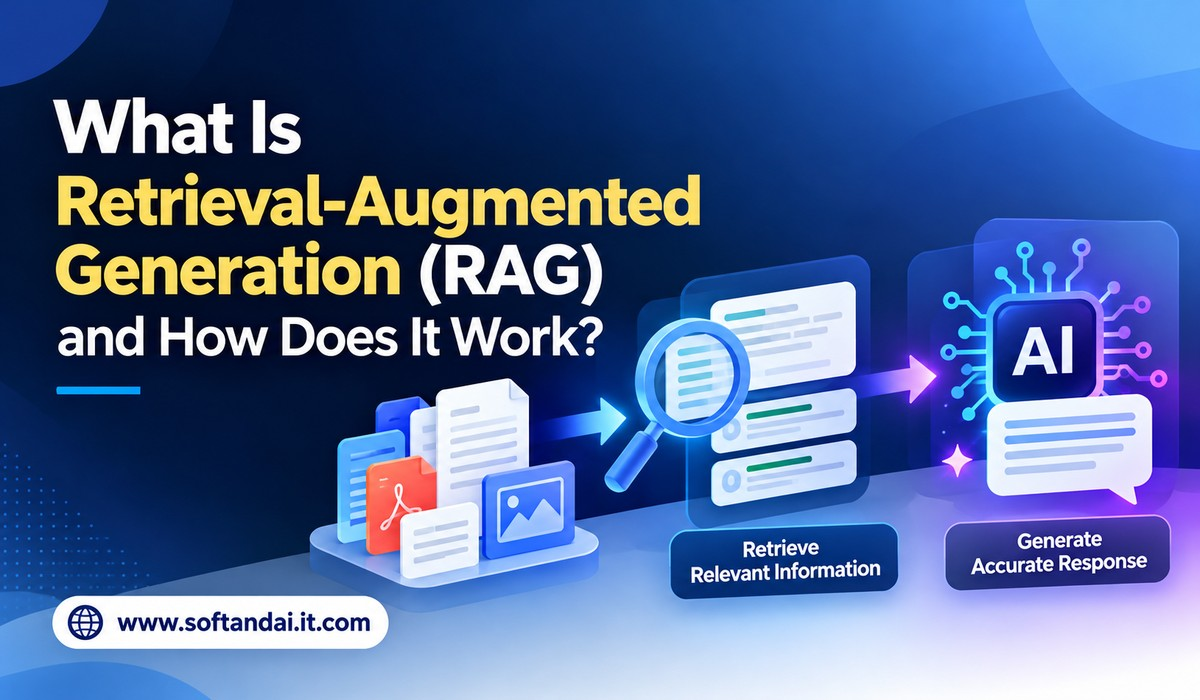
RAG works in a similar way. When someone asks an AI system a question, the system first searches through available information. It finds the most useful details and gives them to the AI model. The model then uses those details to prepare an answer.
For example, imagine an online shopping company has thousands of product descriptions, delivery policies, and customer support documents. A customer asks an AI assistant whether a particular product can be returned after 15 days.
A normal AI system may not know the company’s actual return policy. However, an AI system using RAG can search the company’s documents, find the correct policy, and explain the answer to the customer.
This makes the response more connected to the company’s actual information.
The main purpose of RAG is to combine the language understanding abilities of AI with information collected from external sources. It helps AI systems answer questions using information that may not have been available when the original model was trained.
Why Was RAG Introduced?
Traditional AI language models are trained using large amounts of information. They learn patterns in language and use that knowledge to generate answers.
Although this approach is powerful, it has some limitations. The information available to an AI model may not always be current. A model trained several months ago may not know about a recently introduced product, a new company policy, or an updated government rule.
Another problem is that AI models can sometimes generate incorrect information. This is often called an AI hallucination. It happens when an AI system produces an answer that sounds convincing but is not supported by reliable facts.
Businesses also face difficulties when they want AI tools to answer questions about private company information. General AI models do not automatically know what is written in an organisation’s internal reports, employee guidelines, or customer records.
RAG helps address these problems by giving AI systems access to relevant information when answering questions.
Companies can update their information sources without having to train an entire AI model again. When a document changes, the information stored for searching can be updated, allowing the AI system to use the latest available details.
This makes RAG a practical option for organisations that want to use AI with their own information.
How Does Retrieval-Augmented Generation Work?
RAG works by connecting an AI language model with an information search system. When a person asks a question, the system searches for useful information and sends the results to the AI model.
The AI model then uses the retrieved information to create a natural-language response.
The process may sound complicated, but the basic idea is easy to understand. The system searches first and answers afterwards.
Collecting Information From Different Sources
The first part of a RAG system involves collecting information. This information can come from company websites, PDF files, Word documents, product databases, instruction manuals, reports, and other digital sources.
For example, a company may want to create an AI assistant that helps employees understand workplace policies. It can provide the system with employee handbooks, leave policies, salary guidelines, and other internal documents.
The system processes these documents so that their information can be searched when someone asks a question.
The quality of this information matters. If the documents contain incorrect, incomplete, or outdated details, the AI system may also produce unreliable answers.
Breaking Large Documents Into Smaller Sections
After collecting the information, the system divides large documents into smaller sections. These sections are often called chunks.
This is important because searching through an entire book or a very large document for every question can take more time and may produce less useful results.
For example, imagine a company has a 100-page employee handbook. One employee asks about the number of paid holidays available each year.
Instead of sending the entire handbook to the AI model, the system can find the section that explains holiday rules.
Breaking information into smaller sections makes it easier to find the exact details needed to answer a question.
Each section is prepared and stored so that the system can locate it later.
Storing Information for Quick Searching
Once the documents have been divided into smaller sections, the system stores them in a way that makes searching easier.
Many RAG systems use something called a vector database. In simple language, it is a type of database that helps computers find information based on meaning rather than only matching exact words.
For example, a person may ask, “How can I get my money back?”
The company’s document may contain the heading “Refund and Payment Reversal Policy.”
Although the question and document use different words, both discuss the same subject. A suitable search system can understand this connection and find the relevant information.
This ability makes RAG more useful than basic keyword searching in many situations.
Understanding the User’s Question
When someone enters a question, the RAG system first tries to understand what information is needed.
It examines the meaning of the question and prepares it for searching.
For example, a customer might ask, “How long will my order take to arrive?”
The system understands that the customer wants delivery information. It can then search through shipping policies, delivery estimates, and other related information.
The search process focuses on finding information that is connected to the question rather than simply looking for identical words.
Finding the Most Relevant Information
After understanding the question, the system searches its stored information and selects the sections that are most useful.
Suppose someone asks about a company’s work-from-home policy. The system may find several documents discussing office timings, remote working rules, employee attendance, and leave policies.
It selects the information that best answers the question.
Some systems also arrange the search results according to their usefulness. This helps the AI model focus on the most important details instead of receiving large amounts of unrelated information.
Generating the Final Answer
Once the relevant information has been found, it is sent to the AI language model along with the user’s original question.
The AI model reads the supplied information and creates an answer in simple, natural language.
For example, if an employee asks how many days of annual leave are available, the system searches the official employee handbook and uses the relevant section to explain the policy.
The final answer can be written in a conversational style rather than copying a complete paragraph from the original document.
Some RAG systems can also provide links or references to the documents used to prepare the response. This allows users to check where the information came from.
A Simple Real-Life Example of RAG
Imagine you run an online electronics store. Your website sells mobile phones, laptops, headphones, and other products.
Customers regularly ask questions about product features, delivery charges, warranty periods, and return policies. Your support team receives hundreds of questions every day.
You decide to introduce an AI customer support assistant using RAG.
First, you provide the system with product descriptions, warranty documents, delivery information, and return policies. The system prepares this information so it can search through it quickly.
A customer then asks, “Does this laptop come with a two-year warranty?”
The AI assistant searches the product information and finds the warranty details for that particular laptop.
It then prepares a direct answer using the available information.
If the warranty document says the laptop includes a one-year manufacturer warranty, the assistant can explain that clearly.
Without RAG, the AI system might provide a general answer about laptop warranties. With RAG, it can use the actual information provided by the store.
This example shows how RAG connects artificial intelligence with real business information.
What Are the Main Benefits of RAG?
One of the biggest benefits of RAG is that it helps AI systems provide answers based on relevant information instead of relying only on their existing knowledge.
This is especially useful for businesses that regularly update their products, services, and policies. They can update their information sources and make the changes available to the AI system without rebuilding the entire language model.
Another important benefit is improved accuracy. When an AI model receives information from trusted documents before answering, it has a stronger foundation for preparing its response. However, RAG does not guarantee that every answer will be correct. The search process and the quality of the original information still matter.
RAG can also help reduce the chances of AI hallucinations. When the system has relevant information available, it is less dependent on generating answers from learned patterns alone.
Another advantage is that businesses can use their own information. An organisation can build an AI assistant that understands its products, services, policies, and internal documents.
RAG can also save time for employees and customers. Instead of manually searching through hundreds of pages, users can ask questions and receive relevant answers within seconds.
These advantages make RAG useful for organisations that want to introduce AI into their daily operations.
Where Is RAG Used in Real Life?
RAG has applications across many industries because almost every organisation works with information that people need to search and understand.
In customer support, RAG-powered assistants can answer questions about refunds, delivery times, account settings, and product details. Customers can receive quick responses without waiting for a support representative.
In education, AI tools can use textbooks, course materials, and study notes to answer student questions. Students can ask about a particular chapter and receive explanations based on their learning materials.
In healthcare, RAG can help authorised professionals search medical guidelines, research documents, and hospital information. It can support information retrieval, although medical decisions still require qualified professional judgement and appropriate checks.
In banking and finance, companies can use RAG to help employees find information about account services, financial products, company policies, and customer procedures.
In software development, teams can connect AI assistants to technical guides, internal documentation, and product instructions. Developers can then ask questions about how a particular feature works or where specific information is available.
RAG is also useful in legal services, where professionals may need to search through contracts, case documents, regulations, and other legal materials. The system can help locate relevant sections, but legal conclusions still require proper professional review.
What Is the Difference Between RAG and Traditional AI?
Traditional AI language models generate responses mainly from the knowledge and patterns learned during training. They can answer general questions, explain concepts, and create content without searching external documents every time.
However, they may not have access to the latest information or private business documents.
RAG adds an information-searching step before the AI model creates its answer.
For example, a traditional AI model may explain general rules about returning an online purchase. A RAG-based system can search a particular store’s return policy and explain the actual rules followed by that business.
Another difference is how information is updated. With traditional AI, changing the model’s knowledge may require additional training or other updates. With RAG, organisations can often update the connected documents or database instead.
Both approaches have their own uses. Traditional AI is useful for general tasks, while RAG is especially valuable when answers need to be based on specific or frequently updated information.
What Are the Limitations of RAG?
Although RAG offers many advantages, it is not a perfect solution.
The first major challenge is information quality. If a company provides incorrect documents, outdated policies, or incomplete information, the AI system may use those details to generate an incorrect answer.
The second challenge is searching accuracy. Sometimes the system may fail to find the most relevant section. It may select information that is related to the question but does not fully answer it.
Another limitation is that RAG systems require proper setup and maintenance. Businesses need to organise their documents, update information regularly, and make sure the search system works correctly.
Privacy is another important concern. Company documents may contain confidential business details or customer information. Organisations must control who can access different documents and protect sensitive information.
RAG can also add extra processing time because the system must search for information before generating an answer. The overall speed depends on the size of the information source and how the system is designed.
These limitations do not make RAG less useful. They simply show why proper planning, reliable information, and regular testing are important.
What Is the Future of Retrieval-Augmented Generation?
The future of RAG looks promising as more businesses explore ways to use artificial intelligence with their own information.
AI systems are becoming more useful when they can understand documents, search company records, and provide answers connected to real business activities.
In the coming years, RAG may become a common part of customer service platforms, workplace software, educational tools, and business applications.
Improvements in information searching may help these systems find more accurate results. Better connections with databases and company software may also allow AI assistants to work with more types of information.
Another important development could be the wider use of RAG with images, charts, tables, and other forms of content. This could help AI systems understand information that is not available only as written text.
However, businesses will still need to focus on information accuracy, privacy, and responsible use. Better technology alone cannot solve problems caused by poor information or weak security.
RAG is likely to become an important part of AI development because it helps connect powerful language models with information that people and organisations actually use.
Conclusion
Retrieval-Augmented Generation is an important technology that makes artificial intelligence more useful by connecting AI language models with external information sources. Instead of depending only on previously learned knowledge, an AI system using RAG can search relevant documents, find useful details, and prepare answers based on the information it discovers.
This approach is valuable for businesses, educational platforms, customer support teams, and other organisations that need accurate information from their own documents.
Although RAG still has challenges related to information quality, privacy, and search accuracy, it offers a practical way to improve how AI systems answer questions.
As artificial intelligence continues to develop, RAG may play a major role in making AI assistants more informative, reliable, and useful in everyday life.
Frequently Asked Questions (FAQs)
1. What does RAG stand for in artificial intelligence?
RAG stands for Retrieval-Augmented Generation. It is a method that allows AI systems to search external information sources before generating answers. This helps them provide responses based on relevant documents and updated information.
2. How does RAG improve AI answers?
RAG improves AI answers by finding useful information before the language model responds. It gives the model additional details from trusted documents, which can help reduce incorrect answers and make responses more relevant to the user’s question.
3. Is RAG better than traditional AI?
RAG is not always better than traditional AI. Both have different purposes. Traditional AI works well for general questions and creative tasks, while RAG is useful when answers need to come from specific documents, company records, or updated information.
4. Do businesses need to train an AI model to use RAG?
No. Businesses can often connect an existing AI language model to their own information sources without training a completely new model. They need to prepare their documents and create a system that can search those documents and provide relevant information to the AI.
5. Can RAG completely prevent AI hallucinations?
No. RAG can reduce the chances of AI hallucinations by providing relevant information before an answer is generated. However, the system can still make mistakes if it finds incorrect information, misses important details, or misunderstands the question. Regular testing and reliable information sources remain important.